
How Multi-Dimensional Dependency Visualisation Reduces Coordination Overhead in Jira at Scale
Abstract
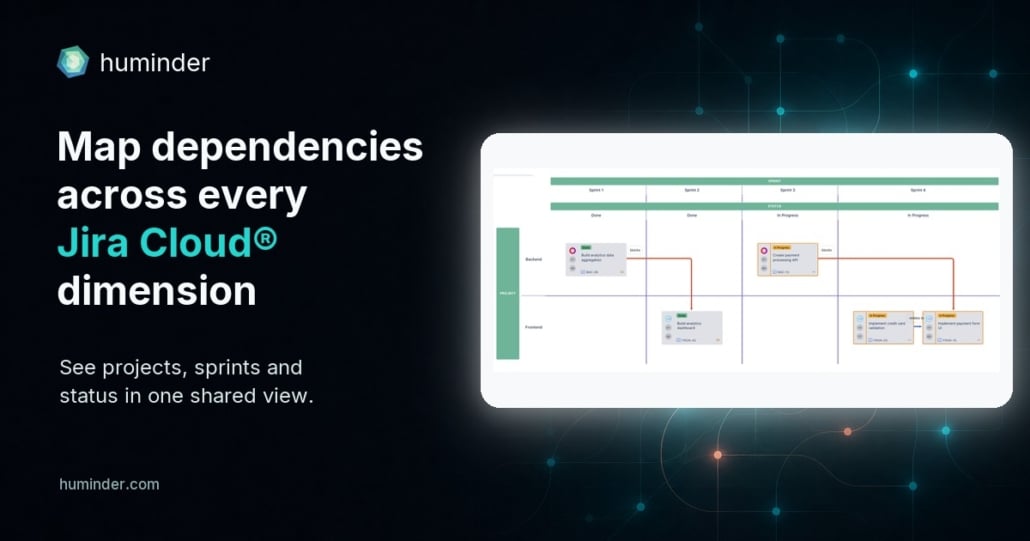
Poorly managed dependencies are a leading cause of delivery delays in scaled agile environments. Traditional dependency views (graphs, matrices, or blocker lists) present information along a single dimension, forcing teams to context-switch between tools and losing sight of cross-project risks. This article argues that multi-dimensional dependency visualisation, where work items are organised across multiple axes (e.g., projects × sprints × epics) simultaneously with visible links, fundamentally reduces coordination overhead. Drawing on research from MIT Sloan Management Review, the Agile Alliance, and Kraut & Streeter’s landmark ACM study on coordination in software development, the article demonstrates how making dependencies visible in context (combining timeline, ownership, and business dimensions in a single shared view) enables proactive risk identification, reduces reliance on coordination meetings, and improves release planning accuracy. An example implementation in Jira (Board Studio, a flexible program board for Jira) illustrates how field-aware, multi-axis visualisation with business logic detection can surface scheduling conflicts automatically and adapt to any organisational structure.
